
Uncertainty hangs over the beginning of 2019 in London. But some of the city’s inhabitants are full of creative optimism.
One such inhabitant is Michał Kamil Piotrowski, an experimental poet who envisages that we’ll soon live in a world of creative machines.
That world is not here yet. But that’s exactly what makes Michał a visionary.
Within his current output in poetry, Michał has been laying the foundations for a space in which machine learning can tip over into machine creativity. It’s an admirable skill to be able to creatively preempt paradigmatic shifts, so I’m excited to find out what motivates him.

We meet in a coffee shop called Canvas Café in Brick Lane, a street known for its curryhouses, vintage shops and street art.
We sit. This coffee shop is basic in a charming way. Think light-toned wooden tables, an assortment of low-maintenance plants, and walls meshed in permanent marker text written by past customers as if the shop is wearing its own history.
Michał co-founded and presents a monthly art event called artBLAB. In each event, five guest speakers give a mini-lecture. The guest speakers are all creatives from different artistic backgrounds and disciplines. The last event took place days before in the basement of the coffee shop where our interview is taking place.
At the event, it was clear that Michał has a contagious enthusiasm for all types of art and a real passion for people. Conversations after each lecture confirmed he’s someone who (really) listens to others when they talk, and who means the questions he asks because he genuinely wants to know the answer.
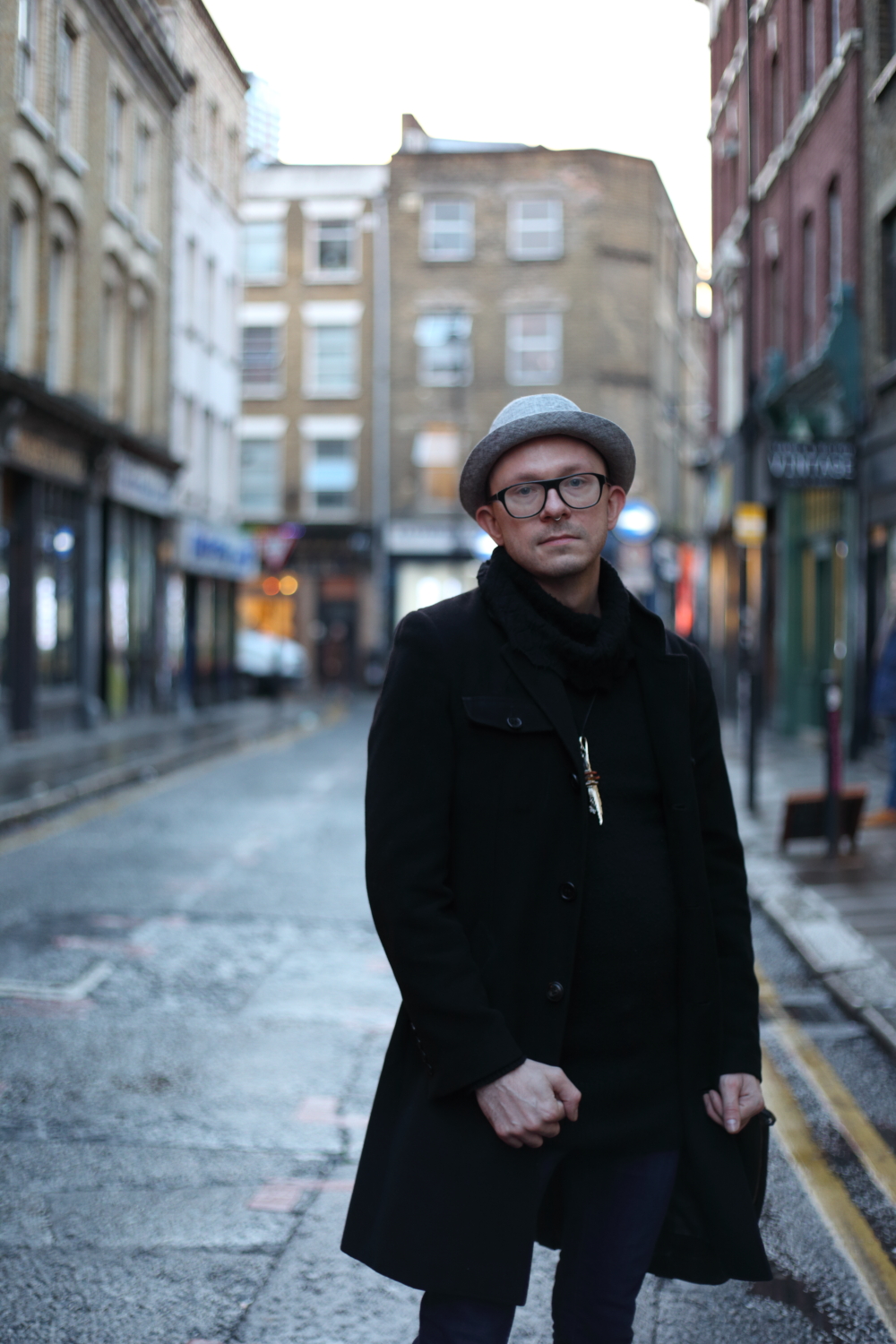
Growing up in Łódź, Poland, Michał began writing poetry in high school.
“I think we all write bad poetry in high school—and mine was really bad. It came from a place of therapy. But I don’t think poetry or art is best when it’s used as a replacement for therapy. At least mine wasn’t.”
Michał got involved in theatre at his school, which was bilingual in Polish and French. Michał toured with the school’s French theatre troupe, performing original plays in Poland, Hungary and France.
Michał also drew and painted, so much so that he wanted to apply to the University of the Arts, Poznan. But prior to making the application, fear kicked in.
It had always been bits and pieces. And I mostly did everything for fun. So when it came to applying I got scared.”
Michał went to career counselling to work out what he wanted to do. With a strength in languages, Michał decided to study a BA in Modern Languages and Linguistics. He specialised in French and Spanish.
Though he continued his involvement in theatre at university, Michał wrote poetry of his own less and less frequently.
Supporting himself by teaching languages, Michał continued on to an MA in Applied Linguistics and Second Language Acquisition, but enjoyed it less than he had his BA; he wanted to further diversify his skillset.
I was so depressed and put down by my studies. I was just so frustrated.”
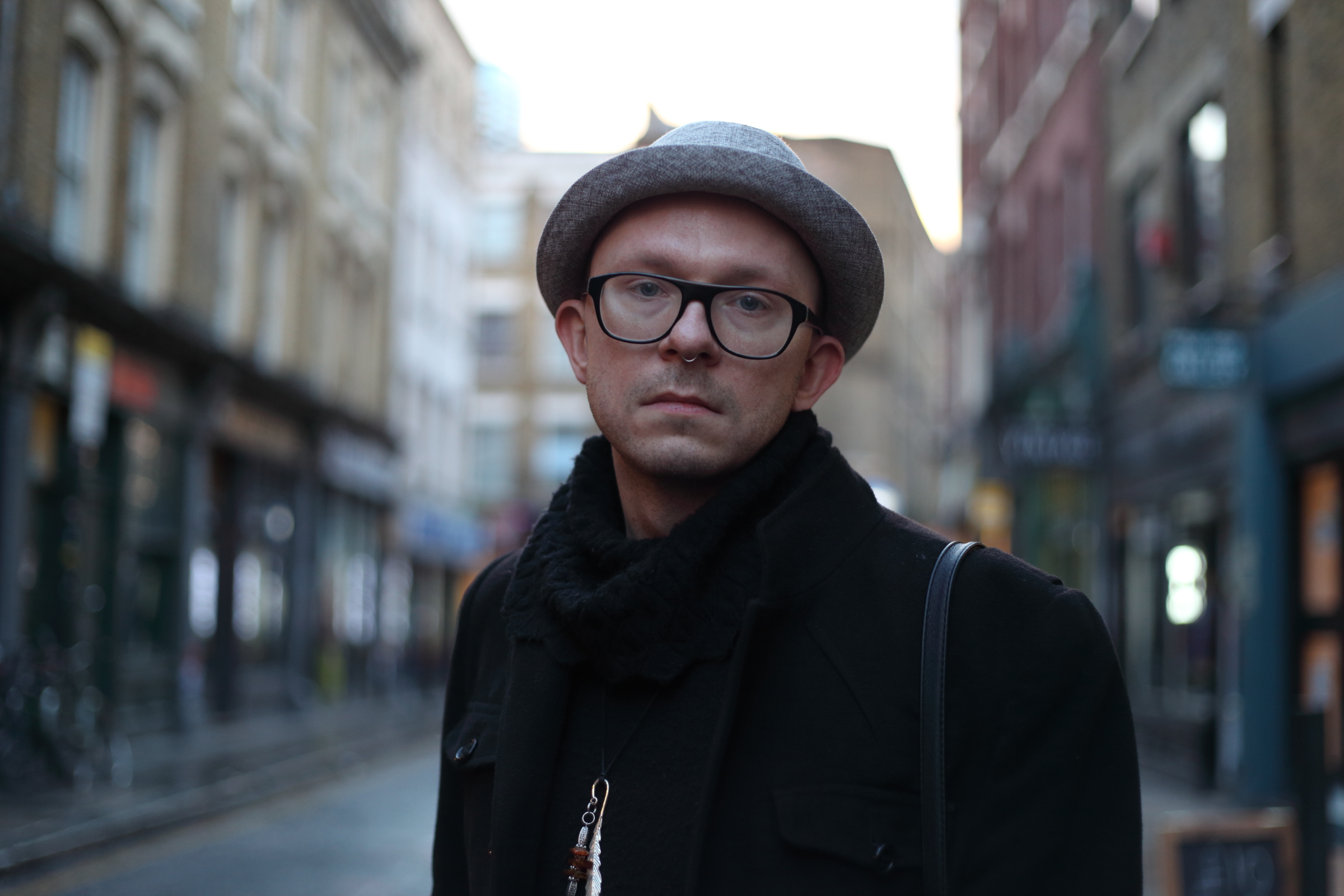
Michał had always been able to blend creativity with the analytical, and was particularly strong at mathematics. So he enrolled on another masters degree in Commodity Science at Poznan’s University of Economics. Commodity Science involved building a wide range of skills, including engineering, economics and marketing, and even the chance to study abroad in Portugal.
“Actually, going to Portugal wasn’t exactly what I wanted. I wanted to go to Spain. But you had to put down three places. I put Barcelona, Valencia and Faro. I got on the list for Faro, but still thought ‘Why not?’.”
Towards the end of his studies, an advertising agency came to his university to give a talk about 360-degree marketing at his university. They also announced a competition for a paid internship. Michał was intrigued. And with the added pressure of needing a job out of university, he applied.
I’ve always been drawn to new directions, whatever I find interesting. I guess it’s just who I am. I’ve never been a specialist. It’s so good to learn new things and not just stick to the field you know.”
Michał landed the internship. And the company liked his work and kept him on. He began working as a copywriter. He relished the opportunity to come up with original ideas and translate them into various types of marketing.
However, after a year, Michał was moved into social media marketing. He worked predominafirstntly on two beer brands.
“I don’t even drink. So it was interesting, but I had this moral dilemma because I thought the function of what I was doing was literally just to make people drink more. Which is not what I identify with. I had to go. When I left the job, I wasn’t even sad.”
In the afterglow of leaving the job, Michał realised he had confirmed one of his principles: he wanted to use his skills for good and write for things he actually wanted to write for.
Michał found a Polish NGO called the Centre for the Promotion of Sustainable Development. He met them and noticed they lacked something he could provide.
“They were amazing people—super hardworking and incredibly knowledgeable about sustainability and environmental protection. But they kind of sucked at marketing.”
Michał helped them figure out how they could sustain themselves financially and generate enough profit to expand.
In 2013, Michał had an idea that would change his life beyond recognition.

Michał went on holiday to London, and stayed with his then-partner’s family. Michał spent some time exploring the city.
It felt like home. I just thought ‘I have to move here’.” It felt like my place on Earth.
Just like that, Michał knew he had to live in London. He formulated a plan to move.
A few months later, Michał went in search of work. He stayed with his ex-partner’s sister. But it didn’t work out.
Michał had tried to find work in his own field as a teacher, and didn’t have enough knowledge of the market. Not only that, Michał got sick with a fever. He left after two weeks.
“I could have taken a bar job or a cleaning job or whatever, just to start. But I didn’t.”
Then, half a year later, Michał revisted London for another holiday.
After two days I thought ‘F*** it. I’m staying.'”
With a suitcase prepared for one week, Michał quit both his jobs in Poland, one by phone and the other by email.
“I found the worst possible job, one where they didn’t even need my national insurance number straight away. They said I can apply for one while working there and just let them know once I have it. I got a temporary number. The pay and the hours were bad. But it allowed me to start.”
Michał found his hub in the form of a pay-by-the-minute coworking space for artists in Shoreditch called Ziferblat, and before long found himself applying to be a host there. Ziferblat allowed Michał to network with creatives and rekindle his interest in creative projects.
At Ziferblat, Michał would see all types of people meeting to work on projects together, not something he’d had the chance to experience in Poland. He soon found himself as its manager.
London teaches you that you can actually take initiative in your life. You don’t have to go where people want you to go. You can do your own things. You can try things.”
Inspired by Shoreditch’s vibrant art scene, Michał dabbled with street art, ran bookworm parties, and took part in photoshoots.
Michał eventually left his managerial role and took on a new role as a sales assistant in a sex shop, followed by a teacher in a sushi restaurant.
In a period of creative exploration, Michał met a new partner: an experimental poet called Stephen Mooney.
“I started reading his poetry and my first reaction was ‘What the **** is that?’ I didn’t know poetry could look that way. I’ve always believed postmodern experimental things don’t necessarily have to be good. I’d have this healthy dose of scepticism, which honestly was just me not understanding it. So I wasn’t great as a reader. But then I actually started reading it and it kind of opened my eyes to experimental art.”
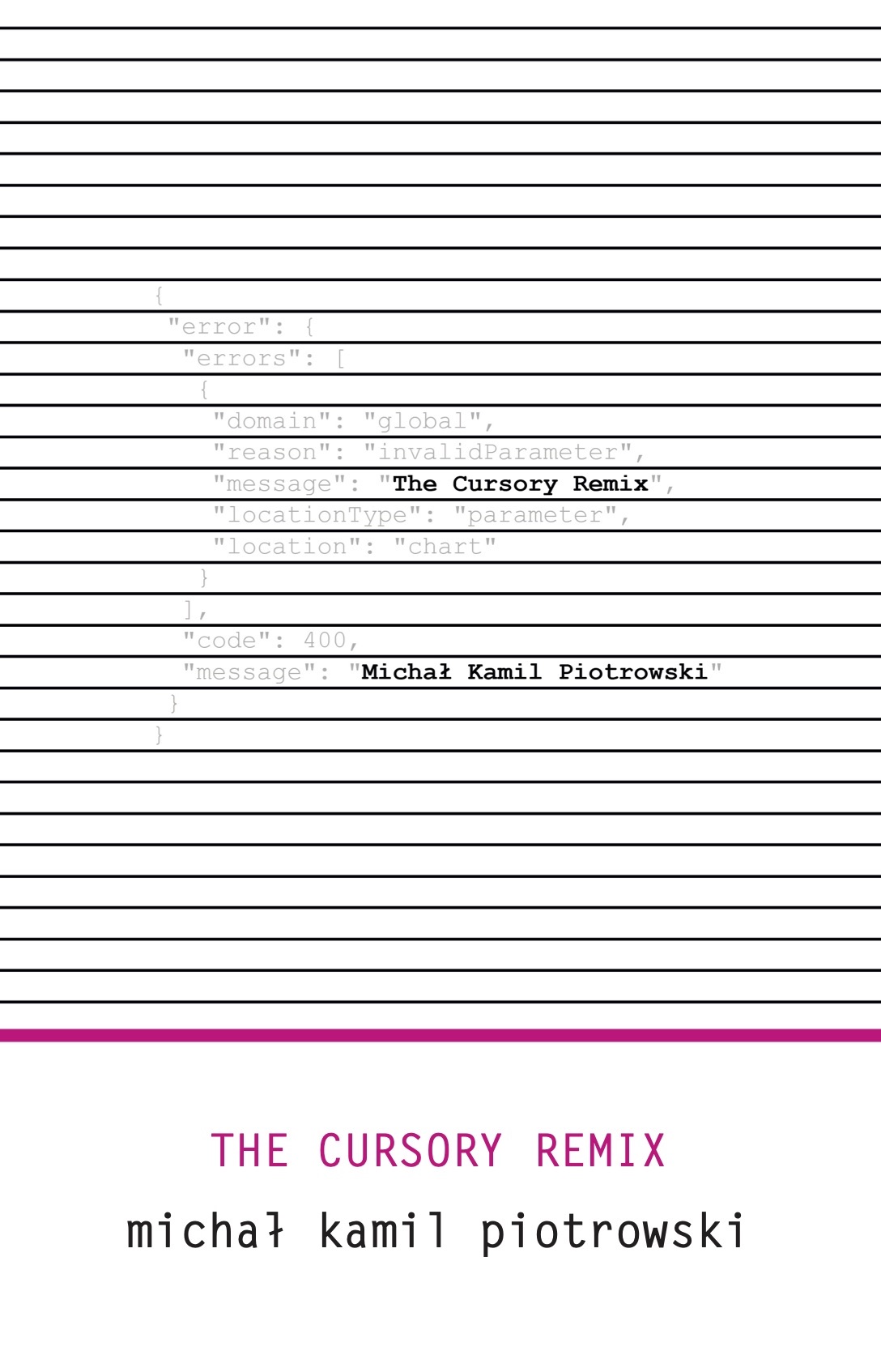
Michał read Stephen’s poetry book and wanted to make his own creative interpretation of it. Pairing his interests in language and technology, Michał ran the book through Google Translate.
“I realised that what I was making was actually a book—I was making a poetry book.”
Michał called it The Cursory Remix:
One night, Michał developed a broader understanding of the art form he was getting involved in.
“It was late in the night. We were lying in bed talking. Stephen proved to me that everything is poetry. It felt like he’d ****ed my brain; it was so powerful and incredible. And I thought ‘Well, I might as well stop laughing at experimental poetry. If it is really valid as art, and it is a type of art that encompasses everything, everything can be poetry. I might as well become a poet.'”
Creative Londoners: How does (or will) “post-human” come into your art?
Michał Kamil Piotrowski: I believe that creativity of machines is something that’s going to start happening soon. We are now able to construct programmes and machines that are able to learn. A couple of months ago Google released a system that can pose as a human. It can call your doctor and book you an appointment. They actually checked and most people didn’t know they were speaking to a computer programme. I believe technology’s going to get more human. Now that it’s able to learn I honestly think it’s going to be able to be creative—and probably even be able to make art. I think it’s better getting prepared in the sense that you can embrace it. You can stay reasonable but you embrace what technology can give you.
What I’m doing is giving part of the space to the machine. What I did with The Cursory Remix—part of that is written by Google Translate. And I wouldn’t edit that. And then I wrote things where I would take texts, like a poem which has a part composed with synonyms of certain words generated from a thesaurus. So I also wouldn’t filter them—I’d write them down. That’s why it’s post-human. I don’t just use the tools. I give space to the machines. It’s obviously not creativity yet. It creates value mostly by accident. But it does create interesting things. So I think that’s why I decide to leave it the way it is without editing it. I edit my part, but give space for machines.
It’s like training my texts and machines. What I’m given back when I feed my machines with text, or find synonyms, I’m being given back certain value. It’s not creative per se yet, but it does give interesting results. When machines become creative on a daily basis, and accessible to everything, then I’ll kind of already be ready. It’s cool to write with another human. But it’s also really cool to use or misuse technology.”
In May 2018, Michał went to an Interaction Design Arts degree show at London College of Communication and found the quality of work far exceeded his expectations of BA output. He wanted to learn about and share the work of the designers, and spoke with some of the students about putting on a talk in collaboration with Ziferblat.
Michał co-founded artBLAB with one of the show’s designers, Miryana Ivanova. Together, they put their first event on in September and have put on several successful events since.

Creative Londoners: What’s the goal with the artBLAB project?
Michał: Firstly, to promote artists we believe in.
Secondly, to mix audiences. For example, usually experimental poets all sit together and they’re together and a separate world. Probably it’s the same way for street artists. But in artBLAB, street artists meet experimental poets and experimental poets meet street artists. It’s just really nice to mix different creatives. I was told by street artist Hello the Mushroom that she might be doing a collaboration with poet Tim Atkins. That’s exactly what I want to happen: to make artists meet.
Thirdly, from a self-centred point of view, it’s an opportunity for me to up my game and organise art events. That’s what I want to do in the future: event organisation and art events. This is part of it: to gain experience for my CV. Also, because I’m an artist, it’s an opportunity for me to liaise with other people and meet with people I wouldn’t otherwise meet. It feeds my creativity as well. It’s self-centred, but it’s only a part which is self-centred.
Essentially, I’d like artBLAB to be something that people recognise. Something that rings a bell. I don’t see it as being something that is profitable. For that, it would need to be a really big event. But what I really like is creating a homely atmosphere in which to talk with artists and people. I don’t think it should go above 50 people. If I asked people to pay more for tickets, it wouldn’t be accessible—which is something I want it to be.
Also, it’s important that the speakers are nice. I know people who’re talented but they’re also arseholes. It might be a little bit harsh, but I don’t think they should be promoted. It’s important to have talent. But also, we only live once and life’s kind of unfair. So that’s why I want people who are genuinely nice. I think art’s better when it’s genuine.
You can follow artBLAB on Instagram and Facebook, and also support the initiative via Patreon.
You can follow Michał’s poetry via Instagram.

 Creative Londoners